
The correct electrical cable size depends on far more than just the appliance or equipment connected to it.
A cable that is too small for the load or installation conditions can overheat, damage insulation, reduce equipment performance and create a serious safety risk. On the other hand, simply choosing the largest cable available is not always practical or cost-effective.
The correct cable size depends on far more than just the appliance or equipment connected to it.
From current requirements and installation method to ambient temperature, grouping and voltage drop, several factors need to be considered before a cable is specified.
This guide explains the key considerations involved in selecting an appropriate electrical cable for an application.
Important: This article is intended as a general guide. Electrical installations should be designed, installed and verified by appropriately qualified and registered professionals in accordance with applicable South African requirements and the specific conditions of the installation. South Africa's Electrical Installation Regulations incorporate relevant safety standards for electrical installations. QUICK ANSWER
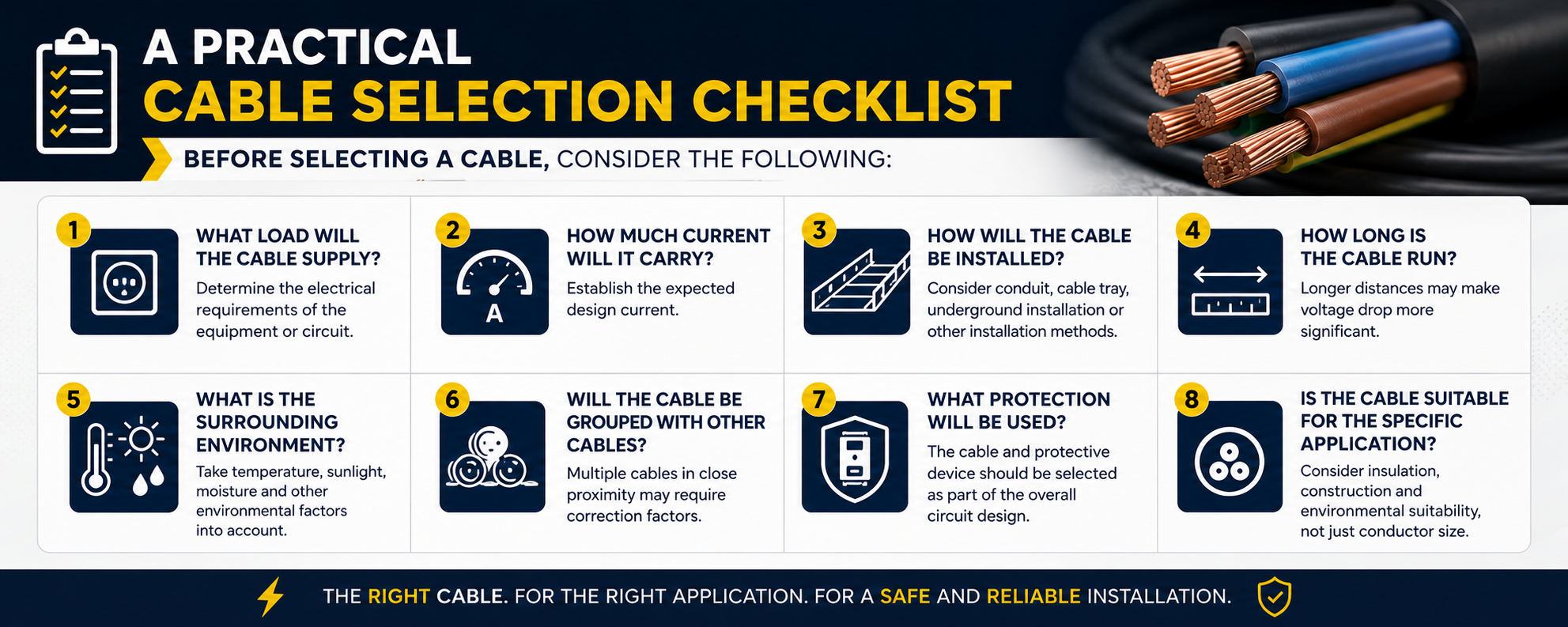
The first step in cable selection is understanding the electrical load the cable will be required to supply.
This may include equipment such as:
The amount of current required by the load plays a major role in determining the correct electrical cable size for the application.
However, the cable’s current-carrying capacity cannot be considered in isolation. A cable that performs safely in one installation environment may require a different selection in another.
That is where the next factors become important.
Every cable has a maximum amount of current it can safely carry under specific conditions.
This is known as its current-carrying capacity.
The rated capacity depends on factors including:
South African electrical installation requirements recognise that tabulated current ratings may need to be adjusted when installation conditions differ from the conditions used to establish those ratings. Factors such as ambient temperature and cable grouping can therefore reduce the effective current-carrying capacity.
Imagine two identical cables.
One is installed individually in a location where heat can dissipate effectively.
The other is installed alongside several loaded cables in an enclosed route.
Even though the cables are physically identical, their operating conditions are not.
The second installation may require correction factors to be considered because the surrounding heat can affect the cable’s ability to operate safely.
Where and how a cable is installed can significantly affect cable selection.
Common installation environments include:
The installation method affects how effectively heat generated by the conductor can escape.
For this reason, cable selection should always take the actual installation environment into account rather than relying only on a cable size used in a different application.
Technical design criteria used in South African projects also specifically consider factors such as installation conditions, ambient temperature and cable grouping when determining cable requirements.
Voltage drop is another important part of cable selection.
As electrical current travels through a conductor, some voltage is lost due to the cable’s resistance.
Over longer cable runs, this becomes increasingly important.
If voltage drop is excessive, equipment may not receive the voltage it requires to operate as intended.
Possible effects can include:
This is why a cable that may be suitable for a short run is not automatically suitable for a much longer distance.
South African cable selection guidance and electrical design specifications consider voltage drop alongside current-carrying capacity rather than treating cable sizing as a single-factor calculation.
More current + longer distance = greater importance placed on cable sizing and voltage drop calculations.
Electrical cables generate heat while carrying current.
If the surrounding environment is already hot, the cable has less ability to dissipate that heat.
This means ambient temperature can affect the cable’s effective current-carrying capacity.
This consideration can be particularly important in environments such as:
Current South African draft standards also identify ambient temperature and direct solar radiation among the conditions that may require correction factors when determining current-carrying capacity.
When several current-carrying cables are installed close together, heat from one cable can affect the others.
This is known as cable grouping.
Examples include:
The more cables operating together, the more important it becomes to consider their combined thermal effect.
This is why simply checking the rating of an individual cable may not provide the full picture.
Cable grouping and the number of cables sharing an installation route are specifically recognised as factors requiring correction during cable selection.
Choosing the correct electrical cable size is only one part of the decision.
The type of cable must also be suitable for the application.
Depending on the environment, considerations may include:
A cable suitable for a protected indoor installation may not be appropriate for an outdoor, industrial or underground application.
The cable and its associated accessories should therefore be selected as part of the overall installation requirements.
The cable and its protective device should be considered as part of the same electrical system.
For example, the cable must be suitable for the conditions under which it will operate and for the protective arrangement associated with the circuit.
Electrical design criteria used in South African projects specifically consider cable current ratings together with fault conditions and protective systems to help prevent cable damage under abnormal operating conditions.
This is one reason cable selection should not be based on appliance wattage alone.
It is tempting to think:
“This equipment needs more power, so I just need a thicker cable.”
Unfortunately, electrical installations are rarely that simple.
A properly selected cable takes into account the complete picture:
Load + Current + Distance + Installation Method + Environment + Grouping + Protection
That combination is what helps determine an appropriate solution.
The required electrical cable size depends on factors including the electrical load, expected current, cable length, installation method, ambient temperature, cable grouping and voltage drop. The specific installation conditions must be considered when selecting a cable.
Potentially. As cable length increases, voltage drop can become more significant. A cable suitable for a short installation may therefore not necessarily be suitable for a longer run carrying the same electrical load.
A cable that is too small for the electrical load or installation conditions may overheat, experience excessive voltage drop or suffer damage. Correct cable selection and appropriate circuit protection are important for electrical safety and equipment performance.
Yes. The way a cable is installed can affect its ability to dissipate heat. Installation in conduit, trunking, cable trays, underground routes or alongside other cables may influence the appropriate cable selection.
No. Electrical cable size must be considered in relation to the specific application. Factors such as load, distance, installation conditions, temperature, cable grouping and protective devices can all affect the appropriate cable selection.
Whether you’re planning a new installation, managing a project or sourcing electrical materials for an industrial or commercial application, having the right cable and accessories available can make the procurement process considerably easier.
Bee Gee Electrical can assist with sourcing electrical products and components for a wide range of requirements.
Send us your requirements or request a quote, and our team can help you source the products you need.
Bee Gee Electrical supplies a wide range of electrical products and assists customers with product sourcing for residential, commercial and industrial requirements. Our Resources section provides practical electrical guides and product information to help customers make more informed purchasing and specification decisions.
Your trusted electrical supplier in Springs for quality products, reliable service and expert support.
Monday – Friday
08:00 – 17:00
Saturday
08:00 – 11:00
Sunday & Public Holidays
Closed